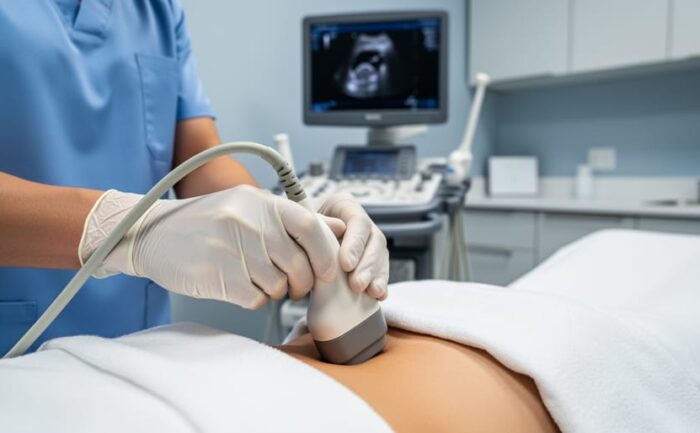
Clinician performing a transvaginal ultrasound exam in a modern women’s health clinic, with the ultrasound probe in focus and medical equipment in the background.

Can Endometriosis Be Seen On Ultrasound? Here’s What Imaging Can and Can’t Detect

Yes, endometriosis can be seen on ultrasound, but with important limitations. Transvaginal ultrasound is quite sensitive at detecting ovarian endometriomas (those characteristic “chocolate cysts”) and can identify deep infiltrating endometriosis when performed by an experienced examiner. However, it cannot reliably detect superficial peritoneal endometriosis, which is one of the most common forms of the disease.
If you’ve been experiencing pelvic pain, painful periods, or fertility challenges and your doctor has ordered an ultrasound, you’re likely wondering whether this test will finally provide answers. The…

Woman in a clinic hallway holding a small notepad and medical wristband, representing preparation for endometriosis diagnosis.

How Is Endometriosis Diagnosed? What Reddit Communities Reveal About Real Patient Journeys

If you’re searching for how endometriosis is diagnosed and specifically turning to Reddit for answers, you’re looking for something doctors’ websites often miss: honest accounts from women who’ve actually been through the process. The clinical answer is straightforward, endometriosis is definitively diagnosed through laparoscopic surgery, where a surgeon examines the pelvic cavity and takes tissue samples for confirmation. But the path to that operating room is where Reddit’s collective experience becomes invaluable.
Women in online communities frequently share stories of spending years seeing multiple …

“Woman in her early 40s standing near a bathroom mirror holding a warm mug, suggesting perimenopause transition and self-care.”

Peri Menopause Age: What to Expect and When It Begins

Perimenopause is the transition period when your body begins shifting toward menopause, marked by changes in your menstrual cycle and fluctuating hormone levels. Most women enter this phase between ages 40 and 50, though the timeline varies widely from person to person. It ends officially when you’ve gone 12 months without a period, at which point you’ve reached menopause.
Understanding when perimenopause typically begins matters for more than just managing hot flashes and irregular cycles. This transition can last up to 10 years, and the hormonal changes during this time have significant implications for your heart …

Woman with her hand over her upper chest, with a stethoscope and smartphone on a bedside table, suggesting heart disease warning signs and self-advocacy.

Personal Experiences Examples That Reveal the Warning Signs of Heart Disease

Personal experiences are the bridge between cold statistics and real understanding, and when it comes to women’s heart health, these stories illuminate symptoms doctors often miss, struggles other women face in silence, and paths to recovery that medical textbooks don’t capture. Women describing their heart attacks as “jaw pain and exhaustion” instead of chest-clutching drama, mothers recognizing their own risk factors in a friend’s story, survivors sharing how they rebuilt their lives after cardiac …

Woman sitting upright in a hospital corridor with her hand over her chest, lit by soft blue and red emergency lights, symbolizing cardiac survival and resilience.

When Hearts Stop and Women Fight Back: Real Stories of Cardiac Survival

Cardiac arrest survival stories stand out as some of the most remarkable accounts of human resilience because the stakes are absolute: when your heart stops, you have minutes, not hours. For women, these survival stories carry an added layer of complexity. Female heart attack symptoms often differ from the classic chest-clutching scenario, leading to delayed recognition and treatment. The women’s…

Canadian woman in a clinic room resting her hand on her chest while looking at a wearable fitness device, representing heart health awareness for women.

Women’s Heart Attack Statistics: The Alarming Numbers Every Canadian Woman Should Know

Every 20 minutes, a woman in Canada dies from heart disease or stroke. Let that sink in. While many of us worry about breast cancer or other health threats, cardiovascular disease remains the number one killer of Canadian women, claiming more lives than all forms of cancer combined.
Here’s what the numbers tell us: approximately 90% of Canadian women have at least one risk factor for heart disease. Among women who experience heart attacks, nearly two-thirds will fail to make a full recovery. …